Prologue:
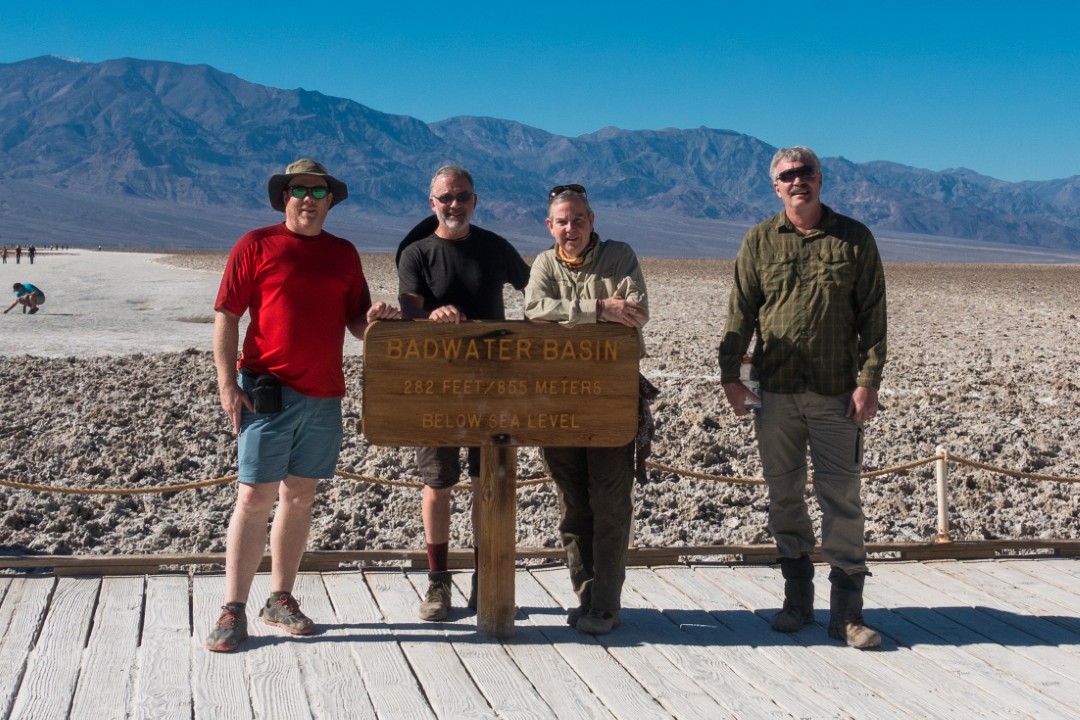
In February of 2020, before the long covid lockdown, four of us—Brian, John, Bob, and I—set up base camp in Furnace Creek for six nights, using it as our jumping-off point to explore the far reaches of Death Valley. The mild winter weather made it perfect for long hikes and backroad adventures, letting us see the park in a way that would be impossible under the summer heat. From dawn photo shoots and canyon treks to ghost towns, dunes, and distant mountain lookouts, each day revealed a new side of this vast desert landscape—and by the end of the week, we’d covered nearly every corner of Death Valley that could be reached by foot or by dusty road.
Each day of our Death Valley trip is represented in it's own album below.
Getting there
Day one
Death Valley surprised us with its beauty. We’d come expecting heat and emptiness, but the landscape unfolded like a living painting. At dawn, we stood on the overlook at Zabriskie Point, watching the badlands change color with the rising sun—gold giving way to rose, rose deepening to bronze. Later that morning, we hiked through Golden Canyon, tracing the same rippled formations we’d just photographed from above. The light bounced off the narrow walls, shifting constantly as we wound through the maze of rock.
Driving deeper into the valley, we followed Artists Drive, where the hills are streaked with pinks, purples, and greens so unexpected they seem almost unreal. Out on the Devil’s Golf Course, the salt crystals crunched beneath our boots, sharp and uneven, like walking across a frozen ocean. Driving further south, we stopped to walk out into Badwater Basin, the lowest point in North America. The white flats stretched to the horizon, and the air shimmered in the heat—silent, endless, and strangely peaceful.
Day two
The next morning, Mosaic Canyon offered a completely different world. We scrambled through smooth marble walls, their polished surfaces twisting and reflecting the light like sculpture. Later that day, we drove north to the ghost town of Rhyolite, where hollow stone walls and a single surviving bank vault stood as reminders of a century-old dream. Just down the road, the Goldwell Open Air Museum added its own desert mystery—ghostly human figures cast in plaster, frozen in poses that caught the late-afternoon light. From there, we looped back toward Death Valley by way of Titus Canyon, a narrow one-way road that wound through colorful rock layers and deepening narrows. Darkness fell as we crept deeper into the canyon, our headlights catching the walls closing in and the gravel twisting beneath us. By the time we emerged onto the valley floor, stars had filled the sky, and we continued on to Furnace Creek—our familiar camp nestled beneath the palms—ready for another quiet night under the desert’s vast, starlit dome.
Day three
In the park’s northern reaches, Ubehebe Crater made us feel small in the best way. Standing on the rim, we could see how the black volcanic cinders stretched in every direction, a reminder of how violent this landscape once was. Beyond it, the road turned even more remote as we headed for the Eureka Dunes, massive mountains of sand rising suddenly from the valley floor. Hiking to the top was slow going, but the view from the crest—nothing but desert and distant peaks—was worth every step. When the wind blew, the dunes let out a low hum, almost like the desert itself was breathing.
Day four
On another morning, we hiked the Gower Gulch trail from Zabriskie Point, threading through canyons until we dropped back into the main valley. Later that day, we drove up to Dante’s View, where the entire basin spread out below us—the salt flats, the distant Panamints, even the faint glint of Badwater far below. That evening, we stopped by The Inn (formerly the Oasis) at Death Valley, a small oasis of palm trees and cool water in a place that otherwise feels untouched by time.
Day five
Before leaving the park, on our last full day we chased waterfalls and history in the far corners of the desert. Darwin Falls was a revelation—a ribbon of water spilling down moss-covered rock in the middle of the driest place on earth. Up in the Panamint Range, the Wildrose Charcoal Kilns stood in perfect symmetry, dark stone domes built to feed the smelters that once mined silver here. On our final hike, Fall Canyon gave us one last taste of the wildness that defines this place: soaring walls, shifting light, and a silence so deep it echoed in our ears.
Last day
Death Valley may be harsh, but walking through it changed how we saw the desert. Beneath the extremes, we found color, texture, and quiet beauty everywhere. It’s a place that humbles you—where every step reminds you how alive the earth really is.
Looking back, the week felt complete—sunrises, canyons, ghost towns, dunes, and even a few hidden waterfalls—but Death Valley always leaves you wanting just a little more. Our only regret was not making it out to The Racetrack, that mysterious dry lake where rocks slowly glide across the playa, leaving trails behind them. Without a four-wheel drive, the long, rugged road was out of reach this time. Still, it gives us a reason to return—because once you’ve seen Death Valley’s light, silence, and raw beauty, it’s impossible not to want another look.
Disclaimer and credits: I used AI for the main story content however it does follow each day pretty closely. A few of the images used were John's and some were Bob's. Most images are mine. I used "Furnace Creek" as our base camp in the story, but we actually moved camp grounds a couple times due to what was available when I made the reservation. We were still near Furnace Creek most of the time.

Pingback: My first time seeing the Grand Canyon - Jay's Journeys